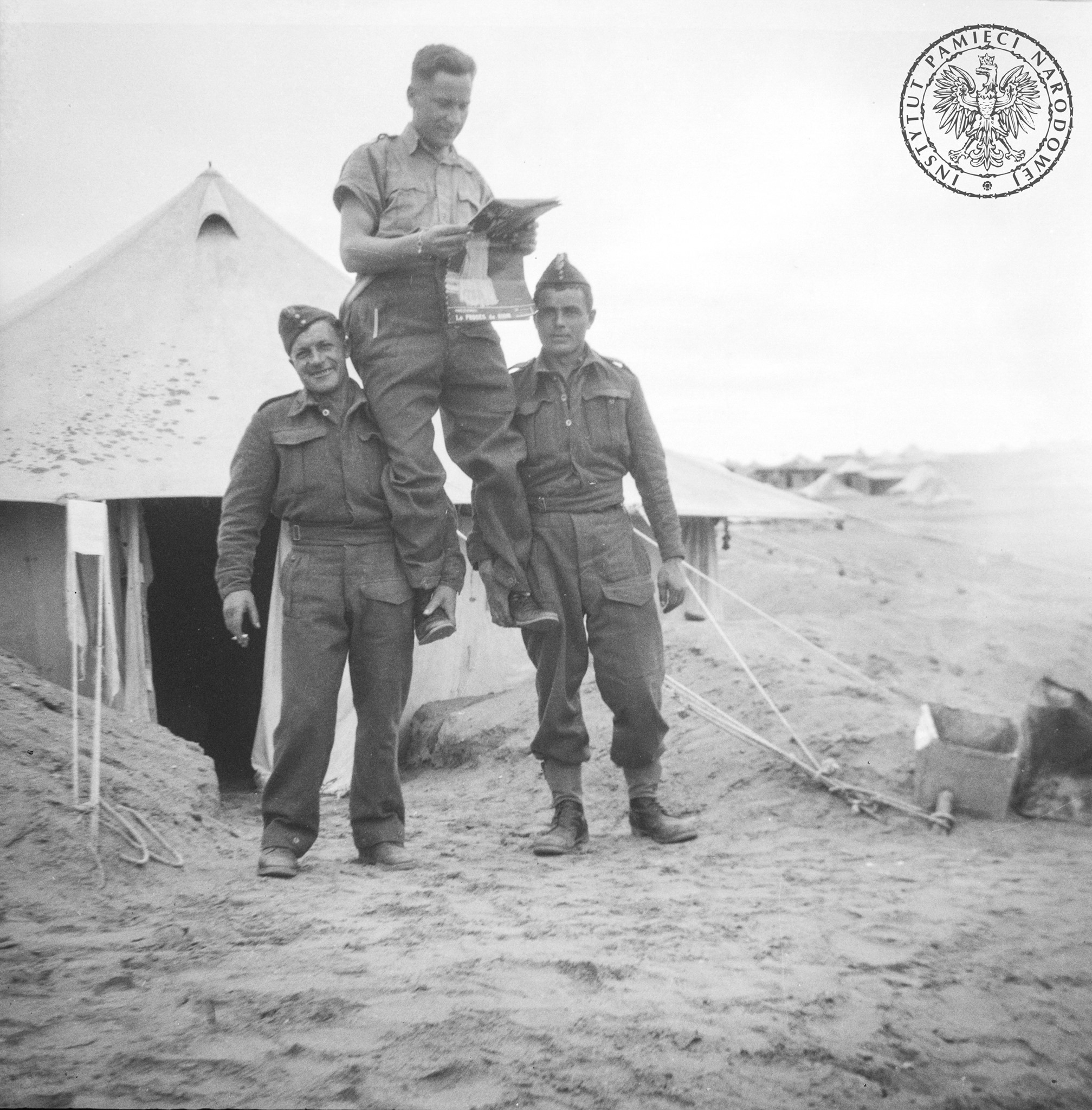
Heluan, a town located in the southern suburbs of Cairo (about 20 km from the city centre) is a former important Polish centre in Egypt. The climatic qualities attracted Marshal Józef Piłsudski to this place in 1932, and a decade later, soldiers of the Polish Army in the East stayed there temporarily in completely different conditions.
The town’s spa conditions were recognised at the end of the 19th century. The dry climate, clean air and, above all, the springs of brine and sulphurous and ferruginous waters attracted visitors from Europe, including Poles, for whom Polish guesthouses were established quite quickly. Guests staying in Villa “Jola”, named after the daughter of its founder, Bogdan Richter, included Tadeusz Smoleński in 1905, Zofia Kossak-Szczucka in 1930, and Marshal Józef Piłsudski in 1932.
In the first half of the 20th century, about 30 burials of Poles were carried out in the Roman Catholic cemetery in Heluana. Among those buried there are Wanda Bilińska - owner of Villa “Wanda”, or Zofia Bobińska, a Polish nurse who went to Heluan for treatment after the First World War and died there at a young age.
Another world conflict brought Polish soldiers from the ranks of the Polish Army in the East to this place where they prepared to fight on the European continent. Before this could happen, however, on 22 December 1943, General Władysław Anders, commanding the Polish troops, unveiled a plaque in Villa “Jola” with inscriptions in Polish, Arabic and English commemorating the stay of Józef Piłsudski.
After the 1952 Egyptian revolution, the town lost its visitors, and industrial facilities were soon erected on the site of the former resort. It now has a population of more than 600,000 and has, among other things, a university and an astronomical observatory.
In 2022, a plaque was unveiled in the Heluana cemetery commemorating the Poles buried there, whose names were reconstructed using data from parish registers.