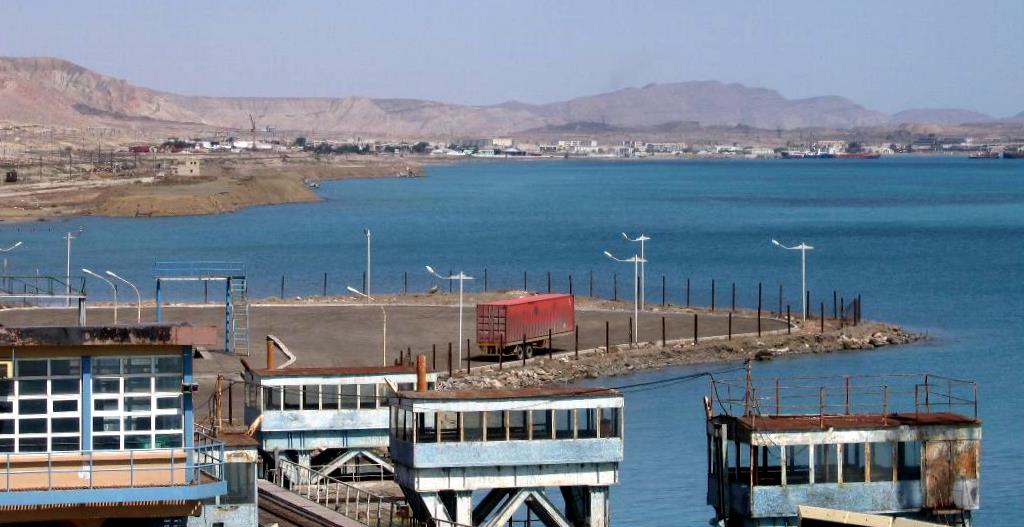
Turkmenbashy is a port in the Caspian Sea basin, located on the bay of the same name. The name of the town and bay was changed in 1993 in honour of Saparmurat Niyazov, the long-time president of Turkmenistan, who began to call himself the “leader of the Turkmen”, i.e. Türkmenbaşy. It was previously known as Krasnovodsk, after the “red waters” of the Caspian Sea. This was a direct translation of the former local name Kyzyl-Su.
It was founded as a military outpost. The first traces date back to the unsuccessful expedition of Peter I’s army against the Khanate of Khiwa. The Tsar hoped that the conquest of the Khanate would provide him with the profits he needed to continue his efforts in the war with Sweden.
In the spring of 1717, his aide, Prince Bekovich-Cherkessky, marched on Khiva with around 7,000 troops. He never came back. From the testimony of the few surviving Cossacks who managed to escape captivity to Russia some time later, Bekovich-Cherkessky’s forces were deceived and separated and then crushed by the Khan’s troops. The head of the Moscow renegade was sent as a gift to the Khan of Bukhara. Bekovich’s defeat also marked the demise of the Krasnovodsk outpost.
Another outpost was established here in 1869. Its development into a fully-fledged urban centre did not begin until 1895, when the Trans-Caspian railway station was relocated here following a catastrophic earthquake. Already a year later Krasnovodsk was granted a city charter.
Krasnovodsk played a special role in the odyssey of Poles leaving the Soviet Union - for many of them, the Collective Evacuation Station located here was the last stop on inhospitable Soviet soil. The first transport sailed from here to Iran’s Pehlevi on 24 March 1942.
Artur Gruber, one of the Polish soldiers, recalled:
On board the Soviet tanker, we left without regret a country of unfulfilled hopes and very sad, grey people. We left behind a cemetery. Epidemics of typhus, typhoid fever and bloody dysentery took a heavy toll on the emaciated Poles. Some claim that more of them are buried there than under the mountain of Monte Cassino. On the second day in the evening, we saw the shores of Iran. Pehlewi harbour was sparsely lit by electric light. Once ashore, hearing the Polish-speaking orderlies who picked up the sick from our transport, I felt like I was in Poland, among my own, safe.
A Polish cemetery was left behind by the evacuees, where 81 Polish soldiers and youths were buried. It has not survived to the present day.
However, the evacuation did not end Poland’s tragic ties with Krasnovodsk. Camp No. 516 was located here, where in the following years people of various nationalities were imprisoned, with a predominance of Germans and Poles, including Upper Silesians, soldiers of the Home Army and the National Armed Forces, liaison officers and nurses of the Home Army. A significant number of inmates were women. The extremely high mortality rate (60 per cent) was due to the harsh climatic and living conditions (lack of fresh water to drink, starvation rations, poor hygiene), hard work in quarries in the desert, repair and construction work, and transport work.
The site has another symbolic dimension: the head of the evacuation and supply base in Krasnovodsk was Lieutenant Colonel Zygmunt Berling, who remained in the Soviet Union after the evacuation, fulfilling his obligations to the NKVD rather than the Polish Army command.